Wednesday, April 22, 2015

Kewaunee County & the Spanish-American War

Veterans' Memorial at Kewaunee County Courthouse, ca. 1908

General Robert E. Lee surrendered to General Ulysses S. Grant on April 9, 1865 and the Civil War was over. However the country was living in its aftermath 32 years later when President William McKinley* asked for 125,000 volunteers to fight a new war. It was April 1898 when without debate both houses of Congress passed a resolution providing for a regular and volunteer army. Wisconsin was asked to supply three regiments.

Some felt the President’s call was much like Abraham Lincoln’s on April 15, 1861 when he asked for 75,000 men. Purposes were different. This time it was for a war with Spain following the February 1898 sinking of the battleship Maine in Havana harbor. In January, before the call for volunteers, Kewaunee County's Frank Slama and Ed Holek went to Milwaukee to enlist with the regular army. G.I. McDonald was the first Algoma resident to “go south” to enlist. Intending to enlist in the Navy, he apparently had a change of heart as he enlisted with Co. I, 1st Wisconsin Volunteer Infantry. Emotions were running high when one prominent business man said he hoped the U.S. would get the “damndest licking it ever got” in the war with Spain. The editor said the man, who also served on the city council, should be “hung from his own lamp post p.d.q.”

The paper noted the flag pole Manager Perry raised at the Veneer and Seating plant. Perry said the flag would not come down until every Spanish soldier was driven from the hemisphere. Residents were displaying flags and children were carrying them. John Raether was in front of the Hotel Algoma on the southeast corner of 4th and Steele, when his horse was spooked by a child waving a flag. A runaway was averted, fortunately, and the only damage done was to his wagon pole.

Orrin Warner, Jr. was born into one of the first three founding families in the place that would become Algoma. Warner was living in Kewaunee at the time and came to Algoma, it was thought, to say good-by because he was answering the call to duty. Warner’s patriotism made the paper, but actually he was in town before he went to Pennsylvania to take a job selling stoves for a company that had operated in the county years earlier. The Alaska correspondent for the Record opined that men in that vicinity weren’t anxious “to manifest their patriotism” as they weren’t enlisting. One identified as Fritz said he’d go if he could get on a torpedo submarine, but the correspondent seemed to think Fritz was crazy, although a man could stay out of the enemy’s sight on such a “new-fangled diving machine.” According to the Green Bay Gazette, brothers Hugh and Robert Minahan had volunteered. The men had interests in both Green Bay and Kewaunee County. By the advent of World War l, the Minahan county interests spanned Algoma, Kewaunee and Casco and included a mercantile, a drug store, and with their brother William who would go down on the Titanic, a maple syrup camp.  Robert was a physician serving the medical needs of county residents and expected to be an army doctor. Hugh planned on the cavalry.

While the country needed men, the Record said the Secretary of War and the Surgeon General of the Army said they did not want women. Their decision was “unalterable” and women would not be employed or trained as nurses to care for the sick and wounded in the war, or be recognized in any other capacity. The paper said such an ultimatum was sure to cause a sensation within the country, and it did. Following the Civil War, there was a pool of nurses and the need for them was urgent.Things changed and by the war’s end, over 1,500 female nurses had served. The public outcry that men on the battlefields needed good care could not be ignored. In tribute, there is a Spanish-American War Nurses Memorial at Arlington National Cemetery.

During summer 1898 the men of General Shafer’s 5th Corp were so sick it was felt the army would die if it remained in Cuba. It was felt that withdrawing to New York for a few weeks would restore health. Dysentery and malaria were rampant, however yellow fever was coming under control Since little attention was paid to Cuban sanitation, the Spanish were blamed for the diseases too.

The country needed chaplains. At an Evangelical Lutheran Synod meeting, it was decided the synod needed a representative with the army in Cuba. The synod’s choice was St. Paul’s Rev. F.J. Eppling who was appointed by Governor Scofield as Chaplain-At-Large. The Algoma congregation gave him a leave of absence on July 10, 1898 and appointed a pastor pro tempore. Eppling returned to Algoma much run down but glad he had served. Ten years later, Rev. Eppling resigned because of failing health and a general nervous breakdown. Following treatment he went to work in the missions in Oregon where he died in 1918. While Eppling didn't die in the war, his death was precipitated by it.

Paying for the war was going to require sacrificing just as the Civil War did. The Manitowoc Pilot said the sentiment of the hour seemed to be “Do things and make others pay for them.” It felt that if the war was so desirable, its burdens should be spread out. At question then was taxing breweries to pay for the war with Spain. After all, it wasn’t the brewers who started the war. That paper felt that some patriots would certainly not feel the consequences of such patriotism. Perhaps those who wanted to rid the country of demon rum thought they had an opportunity to do it.

In April Algoma’s grocers noted that prices were going up. Large numbers of residents were stockpiling stores of food and beverages in anticipation of prices that would surely rise. The grocers said there were those ordering 100# or a barrel of sugar and 50 to 75# lots of coffee. One family bought 50# of tea. In one week sugar jumped 30 cents a 100 pounds, while flour was already 25 cents a barrel more and coffee had risen by 2 cents a pound.

Wenzel Strnad of Casco enlisted in Co. E, 16th Volunteer Infantry in the spring of 1898. By December he was back in Casco on a 30-day furlough, recuperating from malaria. His friends joined together to buy him a gold watch and presented it while he was home. They thought they’d never see him again, fearing for his life following the Battle of Santiago when his mother stopped hearing from him. Of the 84 men in Strnad’s company, only 35 came out alive.  In July George McDonald wrote from Camp Cuba in Jacksonville, Florida. He told how the men drilled 5 days a week, had inspections on Saturday and rested on Sunday. There were no saloons near the camp but there were canteens which sold the products normally found in one. Rio Creek’s James Stennard was in Cuba with the regular army in July. Former resident Fred Bosenberg was another enlistee. Fred was a child when his father owned the cigar store in the north side of the Bastar Hotel on the northeast corner of 4th and Clark, but residents remembered the family. Strnad was furloughed when Ben Fagg, who served in the Civil War, answered the second call for volunteers and  enlisted in Co. B, 3rd W.S. Infantry. Fagg had expectations of being sent to the Philippines where things were already heating up.

The Spanish-American War was short, lasting the summer of 1898. The Philippine-American War is a separate conflict fought between 1899 and about 1902.

About a year after the Philippine-American War was over, it seemed as if newspapers were looking forward to more wars when readership was informed in March 1903 that future battlefield gunshot wounds would be less awful. Dr. Nicholas Sen was one of five American delegates to a medical conference in Madrid where he was quoted saying, “War in the near future will lose a share of the horror.”There was a new method of treating wounds with an antiseptic that would be “a boon to humanity” since it helped prevent infection. Such a dressing had been used during the Philippine-American War and had achieved “wonderful results in preventing mortality” on the battlefield.

A few years later, May 1905, it was announced though Memorial Day had been mostly reserved to honor those who died in the Civil War, those who died in the Spanish-American War and the War with Mexico would also be remembered. The article pointed out that in the years following the Civil War, Memorial Day broadened to become a national event.


* William McKinley had a tie to Kewaunee Co. Ferdinand Haevers was a Belgium immigrant to Kewaunee Co. and in New Orleans when the Civil War began. Caught up in all the war hoopla, he enlisted in the Confederate army. While foraging he saw an officer ride into a clearing. Feeling it would be murder to shoot, he remembered his training, that an officer without a horse was as good as dead. So he shot the horse. The shots brought McKinley’s men. Haevers went to a POW camp for the 2nd time in his military career. Had Haevers followed his first instinct and shot, the course of history would have been changed.

Veneer and Seating Plant became U.S. Plywood and is now Algoma Hardwoods.

Sources: Algoma Record newspapers; An-An-api-sebe: Where is the River?. c. 2001; History of Commercial Development in Youngs and Steele Plat and Other Selected Properties, Algoma, Wisconsin, c. 2006; Yours Truly, from Kewaunee County, c. 2012; Questions answered by R. Horton, Reference & Outreach Archivist, Wisconsin Veterans' Museum, April 2015. Postmarked in 1908, the postcard is part of the blogger's collection.

Wednesday, April 15, 2015

Kewaunee County & the Assassination of Abraham Lincoln

One hundred fifty years ago this week, Kewaunee County was in the midst of the tumult enveloping the nation. But communications as they were, the county was not on the cusp of breaking news. Perhaps that’s why it took the Enterprise* so long to announce the assassination of Abraham Lincoln. By then most had heard the president was shot. Newspapers arriving via the schooners contained more information than the Enterprise ever did. When the Enterprise did carry news two weeks later, it was not headline news, however the columns on interior pages were edged with heavy black lines.

Although Abraham Lincoln won the popular vote in Wisconsin’s 1860 presidential election by a few tenths over 56% and 55% of Wisconsin’s vote in 1864, he was not popular in Kewaunee County. In May 1860 the Enterprize* reprinted an article from the Green Bay Advocate saying Lincoln’s nomination at the Chicago convention astonished everyone, even the party. The paper editorialized commenting that the nomination put a “wet blanket” on Republican election hopes and said that within a day’s drive, the paper could find 20 Wisconsin farmers who were equal to Lincoln.

As it was, Stephen Douglas carried Kewaunee County by 362 votes in 1860. Lincoln’s opponent – and one of his Civil War generals – George McClellan carried the county 753 to 157 in 1864. When Lincoln was inaugurated on March 4, 1861, both Democrats and Republicans attended a celebration at James Slausson’s in Kewaunee. Guests came from Ahnapee and Carlton as well as Kewaunee. A few weeks earlier, a ball on George Washington’s birthday was designed improve the county's political discord. Whether the paper didn’t note attendees from the other towns or whether those from other towns just didn’t show up to toast Lincoln remains a question. Mr. Lincoln was even less popular in 1864 when he received 1 vote to McClellan’s 89 in the Casco precinct. Franklin wasn’t much better at 3 votes to McClellan’s 82. In 1862 Wisconsin was the only state allowing soldiers to vote outside of their state districts, or vote by what today is an absentee ballot. By 1864, 19 other states offered the same privilege.

Kewaunee County’s population was largely immigrant in 1860 and it had grown by 1864. The county was young, made up of families with young children. Few of the immigrants were Naturalized by 1860 and many of the new arrivals had yet to take out first papers called Declaration of Intent. This blogger’s first two immigrant families arrived in Wolf River (Ahnapee and now Algoma) in 1854. They were among the Germans fleeing conscription. One of Euren's settling families was said to have bribed border guards for the same reason. They weren’t alone. German immigrants knew much about subservience and could at least guess about the horrors of slavery. Most had never seen person of any other color so could not really identify themselves with others, however they knew they did not want war. They were new to American and the war was not theirs, yet my German ancestors and thousands of others were drafted and did go, willingly and unwillingly. My French Canadian ancestors were in Manitowoc County at Statehood, having arrived in Quebec in 1660, One great-grandfather fought on the side of the British in the War of 1812. His father was on the Plains of Abraham in the French and Indian War.They were awarded Canadian bounty land. Their sons and grandsons dressed as women by day to work the fields on their Manitowoc County farms and hid in the woods of when conscription gangs were around. They weren’t alone either.

When the men of Ahnapee got the news about Lee’s surrender at Appomattox, it was said they'd worked all day in Eveland’s swamp (today Perry Field) to cut and trim a victory pole to be used in celebration. After carrying the pole down Steele Street to Franz Swaty’s store at the corner of South Water(today Navarino) and Steele, the men were just ready to raise the flag when the Two Rivers mail carrier got to town with the news that President Lincoln had been assassinated. The flag was raised, but to half mast.

The April 12th Enterprise ran a small article about Lee’s surrender, saying it was good news and that recruiting and drafting would cease. There were no headlines proclaiming the end of the war, nor headlines about the assassination. Since the first page of the paper was pre-printed, maybe that was why. The second page of the April 24th paper had thick black lines between the columns with a column title announcing “Terrible News.” The president was shot on April 14th, dying in the morning of the 15th.

The Advocate ran a short article on April 20th telling about the president being shot at Ford’s Theater by “Q. Booth,” an actor. Calling him a desperado, the paper said he called on Secretary Seward who was ill. Gaining entrance to the home by indicating he was from the ailing secretary’s physician, he attacked the secretary’s son, “cut down” two attendants at the secretary’s door and cut the secretary’s throat. The paper went on to mention the wild excitement in Washington and how the vice president and the various secretaries were being guarded. An addendum to the article said the president died at 6:22 AM, that Secretary Seward died at 9:30 and that his son Fred had also died. That same paper ran letters between Generals Lee and Grant and notice of the surrender. There were no screaming headlines, and the brief article appeared near the bottom of page 2.

Once again on April 27 the Advocate carried an article near the bottom of page 3. The piece discussed “a nation’s bereavement for the Savior of the Country.” It was just under an article about the first vessel of the season!

History tells us that that the “facts” in the papers following the assassination were often incorrect. As the months and years rolled on, much more information came to light, some of which was chronicled by the papers. One hundred fifty years later, one could spend a lifetime researching Abraham Lincoln, his life and its ramifications.

*The Enterprize became the Enterprise in 1865.


Sources: An-An-api-sebe, Where is the River?, c. 2001; Ahnapee Record, Door County Advocate, Kewaunee Enterprize/Enterprise, Wisconsin Blue Books online at http://digital.library.wisc.edu/1711.dl/WI.WIBlueBks

Thursday, April 9, 2015

Kewaunee County & the War of 1812

On June 18, 1812 President James Madison signed a declaration of war against Britain, and for the next 2 1/2 years the U.S. was involved in what came to be called the War of 1812. At the time, present-day Wisconsin was part of the Illinois Territory. Twenty-four years after the war began the Wisconsin Territory was split off from Michigan which achieved Statehood. Twelve years later, in 1848, the State of Wisconsin was admitted to the Union. Door County was set off from Brown in 1851 and Kewaunee County was separated from Door the following year.

A generation or two ago, when the average U.S. history high school classes learned about the war, it was about the British burning the capitol, Dolley Madison rescuing the painting of George Washington and Francis Scott Key writing the lyrics to the Star Spangled Banner. The War of 1812 got so little class attention that some only passed the test because of Johnny Horton’s 1959 hit song The Battle of New Orleans and how “we ran through the brambles and we ran through the bushes”……. to chase the British through the town of New Orleans to the Gulf of Mexico.

So what does Madison’s declaration of war and that which became known as the War of 1812 have to do with Kewaunee County? Nothing that invites national monuments, tourism and summer vacations, yet there is a connection.

With the exception of French explorers Jean Nicolet, Pere Marquette, Samuel de Champlain, and Robert de LaSalle among others, there isn't any history of Europeans in what is Kewaunee County until the days of the Michigan Territory.  On the frontier as they were in 1812, the two oldest settlements in what would become Wisconsin - Green Bay and Prairie du Chien which had residents of European ancestry - were important to the U.S., to the French and to the British alike. Before the war, Native Americans and the French fur traders in today’s Wisconsin had pelts to market, thus needing both the British and the Americans. Inter-marriages meant there were also social relationships.  And, while naval battles were being fought in the eastern Great Lakes, the British topsail sloop Felicity patrolled Lake Michigan, including off the coast of today’s Door and Kewaunee Counties. Although the sloop carried four swivel guns and its crew numbered only 12 men, the Felicity was a show of force. But, a show a force to whom?

The Felicity, piloted by Samuel Robertson, is believed to have been patrolling years before the war ever started. One story is that the sloop's presence was intended to prevent the Pottawatomie from joining the Americans. Another is that after the war began the patrolling ship’s captain had reason to believe the Pottawatomie near today’s Two Rivers had large stores of corn for which he hoped to trade rum and tobacco and then take the corn to the garrison at Mackinac Island. Did it happen? The Felicity was said to set sail after the Indians convinced the captain that supplies were low and they only had enough for the winter, but who really knows? Histories mention the British ships Welcome and Archangel sailing Lake Michigan serving in similar capacities. Though crews were small, the booming guns were considered more than enough strike fear among the Indians.

Mackinac Island today
digitalmi.com
Had the captain managed the trade for the corn, he would have been popular at Mackinac Island. In July, the month after Madison’s war declaration, the British captured Fort Michilmackinac on Mackinac without a fight. Though about 400 Indians from 5 or 6 tribes were there to aid the 200 British in the capture, they didn’t have anything to do. The 60 or so Americans on the island became aware of the British only after they fired a single canon shot and as the Americans were outnumbered 10 to 1, they couldn’t do much but surrender the fort. It was retaken in 1814.

Chief War Thunder is well known in Kewaunee County history. Lesser known is his brother Wampun. History tells us that the bands of Pottawatomie along the western shore of Lake Michigan were building boats and storing corn with plans to support the Americans. History also says as friends of the Americans, the brothers took their bands to Mackinac in an effort to offer help. What happened then is a another question.

With the Americans and the British at war, Indians and trappers had to choose sides and most chose the British, although some tried to remain neutral. Green Bay residents generally sided with the British as did bands of Sac, Winnebago, Menominee, Ottawa and Ojibwa. Wisconsin’s Pottawatomie supported the Americans, while flip-flopping alliances at times. The Pottawatomie, Ojibwa and Ottawa made up the Three Fires Tribes, however they saw things differently. Tribes banding together in support of the British were often at odds among themselves, but their common goal was working together to prevent American settlement, which appeared to be a far greater threat than British settlement. As the Americans pushed westward, the Indian people knew it did not bode well for them.

As it was, Indian civilization was already disrupted as the settlers kept moving. In the previous 50 years alone they had been affected by the French and Indian War, by the Revolutionary War, by loss of their lands and by disease. While the Native Americans were trying to protect their interests, John Jacob Astor’s American Fur Company already was operating on Mackinac Island. Knowing about President Madison’s declaration, Astor ordered his stores to be moved south to the mainland of Michigan.

While the British ships were patrolling Lake Michigan, a future resident of Kewaunee County was serving in the war. Joseph McCormick was born in Pennsylvania in 1787. He became a river pilot, running lumber from New York to the Chesapeake Bay. He fought in the war, achieving the rank of major. When it was over he relocated to Indiana and then to Manitowoc while Wisconsin was still part of the Michigan Territory. By then the Black Hawk War was over, the Indians had ceded their land, and life for Wisconsin's Native Americans had changed forever.

McCormick was living in Manitowoc in 1834 when he learned from the Pottawatomie about the lands to the north. Their stories piqued McCormick’s curiosity, prompting him, and others, to want to see such a place for themselves. Sailing north, they came to the present Ahnapee River. Somehow they negotiated the sand bar at the mouth of the river and sailed up-river for a distance of 9 miles, an impossibility today. Near what is now Forestville, the men came across a small island which they named McCormick in honor of their leader. After doing some exploring, the party returned to Manitowoc with glowing reports about the heavily timbered land, the game and the overwhelming numbers of fish. While northern Kewaunee County sounded like nirvana, there were no takers until the spring of 1851 when John Hughes and Orrin Warner decided to check out the area themselves. A few months later, the Hughes and Warners were two of the first three founding families of the city now called Algoma. Hughes built his log cabin on the bluff on the north side of the river, near the site that would become the lighthouse keeper’s home 50 years later. Hughes’ neighbors were Pottawatomie, the best neighbors the early settlers could have had.

As for McCormick – history says he was impressed by the beauty of the north side of the river and felt it was the place to start a town. Things didn’t turn out as he envisioned and when he returned 20 years later in 1854 he went to the area that is now Forestville, making his home along the Ahnapee River, near the county line, before eventually relocating to Ahnapee. The war changed the old veteran’s life also, but not nearly in the way it changed his Pottawatomie neighbors.

In 1870 at age 84, McCormick was the oldest person ever elected (at that time) to the Wisconsin Assembly. The year also marked a visit from McCormick’s 80 year old brother Col. Henry McCormick of New York. It had been 42 years since the Major saw his younger brother the Colonel who had also served in the War of 1812.  Whoever said, “You can’t keep a good man down,” surely had a man like McCormick in mind because within a year the elderly man was so ill there were fears for his life. He bounced back. Appropriately, on July 4, 1873, Ahnapee celebrated the 87-year-old Major McCormick's contributions to the area with a picnic at Rosia Park. It was said forty men paraded with an open carriage to call for McCormick at his residence. Though he was suffering physical problems resulting from a carriage accident sometime earlier, McCormick's mental acumen was not affected. Before a thunderstorm came up curtailing activities, speakers recognizing McCormick were calling the well-respected man the "Father of Ahnapee." A month later McCormick's visit to Kewaunee prompted the Enterprise to presume he hadn't aged, saying that at 87 he was "just as fresh and vigorous on public matters as he was 50 years ago." McCormick died in 1875 and is buried in Algoma’s Evergreen Cemetery.

When McCormick died, there were few Pottawatomie left in Kewaunee County. They had been driven out for non-payment of property taxes, losing their lands in the westward push just as so many tribes feared. Though the Pottawatomie left the area, they left their history in arrow heads and tools, and in the land deed rock on display at Kewaunee County Historical Museum. Letters exist. Exactly 100 years after Madison’s declaration, Jacob Jakubovsky was planting potatoes on the north slope of the south bluff of today's Algoma when he found a peace pipe. Carved from pipestone, the pipe was said to have a reddish tint. If that pipe was smoked with a British captain seeking to trade, nobody ever knew about it.


After the war, soldiers who served were awarded land, and there was plenty of it in Wisconsin. Samuel G. Goodrich was a Private in Captain Johnson's Co., Connecticut Militia, during the War of 1812. On February 9, 1860 President James Buchanan's signature was affixed, via his secretary, to Warrant #65034 whereby Goodrich assigned his 120 bounty land acreage to John Crawford. Goodrich's land comprised 120 acres in the SE 1/4 of the NE 1/4 of Section 20 and the W 1/2 of the NW 1/4 of Section 26 of Township 22, Range 23 in the District of Lands subject to sale at Menasha. The Warrant became (land) Patent #65934, United States to John Crawford.

T. Duescher photo, c. 2009
The marker originally put on McCormick’s grave deteriorated and disappeared. His grave site appeared to be forgotten until in recent years his great-grandchildren marked the spot with a new monument which seems to be Kewaunee County’s only remaining tie to the War of 1812. February 2015 marked the 200th anniversary of the end of the war.


Note: About 80 years later Simon Pokagon addressed the 1893 Columbian Exposition in Chicago. A recognized author, Pokagon was referred to as the last hereditary chief of the Pokagon Band of Pottawatomie Indians. Pokagon called the advance of the Americans, "The cyclone of civilization rolled westward." More about him, his writings and speeches can be found by Googling his name.

Sources: Algoma’s newspaper archives; An-An-api-sebe: Where is the River?, c. 2001; Mackinac Island history; Wikipedia; Map of Mackinac Island was taken from digitalmi.com; McCormick's stone is courtesy of T. Duescher and the Warrant was originally in the blogger's files.


Friday, March 27, 2015

Anti-Treating Movement: Temperance in 1874 Ahnapee


Knights of the Iron Band was one of Ahnapee’s early societies. Unlike the earliest of Wolf River organizations – the Philothean Society, for instance – it wasn’t a literary group. It wasn't a veterans' club or a sewing circle either. Knights of the Iron Band addressed anti-treating. And what is anti-treating? Just that. But it was that to which one could not treat another -  beer or spirits. Anti-treating was an early local effort to control John Barleycorn. One could drink as one wished, however he could not buy someone else a drink.

Alex Doak, John Doak, Orange Conger, Michael McDonald and George Wing were the charter members of Ahnapee’s  Lone Lodge #1 of the Knights of the Iron Band when it organized on January 3, 1874. With the exception of Wing, the men were sailors with three being captains. Wing was the 17 year old editor of the fledgling Ahnapee Record. Membership, which met in the Temple of Honor building, grew quickly according to History of Northern Wisconsin. Where some community members saw the group as “diabolical and horrible,” others thought it as merely strange because of its secret nature.  

Non-members had the opportunity to see for themselves when they were invited to a Lone Lodge meeting in April 1881. Most surprising was the catafalque draped in black, holding the clay representation of a man. Candles stood at each corner. Men taking office that day promised temperance because excess was degrading, opening the door to misery and suffering. A member's obligation was to neither accept from, nor treat another in places where malt or spirit beverages were sold. Members wore their black robes, but had to forego the most secret parts of that meeting as the public was present. Earlier in the year, on a mild January evening, the community witnessed Lodge members dressed in their regalia parading in Ahnapee.

Lone Lodge #1 had a membership of 50 when the building was destroyed by fire. Nothing was saved. Without a hall, their accouterments and regalia, membership became lax and by early 1900s, the group faded from existence. During the meetings men were encouraged to “rat” on each other and those violating their pledge were drummed from the society. It was said there were often expulsions of young men  who were sometimes careless or ridiculed into treating by others. In later years it was said the group’s membership included most of the business and professional men in town and throughout the entire area.

Knights of the Iron Band was a temperance group, but it did not believe in prohibition. Its membership included saloon owners and those whose habits were well known. Though it supported Temperance, the group was not supporting total abstinence. Members were required to be moderate in their drinking while avoiding excess. They were not allowed to treat or accept a drink from another and that is what caused all the controversy, and sometimes even humor.  The History of Northern Wisconsin opined that Ahnapee had a claim to fame as its society was organized years before (the book was compiled in 1881) and Ahnapee “may therefore be the dominant pioneer city in the anti-treating campaign.”  When such laws were introduced throughout the country in later years, it was a recognized fact that the movement had its roots in Ahnapee/Algoma. One hundred forty years later, more than a few would think, “Say what! This happened here?”

An Anti-Treating Bill found its way to Wisconsin’s Legislature in 1877 and by March 1881, Gov. Smith signed the bill which had passed both houses. Fines of 5 and 10 dollars were assessed for offenses. Some felt the law was ludicrous, but others felt it was positive as a man could drink as he chose while not adding to his neighbor’s problems. Treating was said to be part of the generosity of an American, but treating was also said to be a nuisance. Anti-treating was a law that was open to disregard. And, it was. A month later Judge Mallory in Milwaukee had a test case. His ruling was such that the law was disposed.

The February 6, 1915 issue of the Record pointed out that those who originated the group were “more or less addicted to the flowing bowl,” which was one of most effective temperance effort ever because it converted men to a more temperate use. From Wisconsin, the idea spread. Tacoma had an anti-treating ordinance in 1912. Some saw it a violation of rights but it was ruled legal. Nevada passed such a law in 1885 but repealed it two years later. At the time anti-treating was coming to the fore in England, there was concern about stay-at-home-patriots showering soldiers with too much kindness. Much was also written about anti-treating movements in Ireland just after 1900

Ahnapee's history doesn't record the number of violations and the fines. It doesn't record who was standing by in the saloons ready to nab the abuser. Beer was part of socialization among the hard-working German, Bohemian and Belgian immigrants, and reading through the charter and original members, one wonders how it ever came about. That saloon owners were among the members says they weren't worried about their bottom line. If a man couldn't buy a round, he'd more money to spend on himself.

Following is the original original membership as listed as found in an April 1904 Algoma Record:
Michael McDonald, Alex Doak, George Wing, Andrew Bennett, I.W. Elliott, Henry Schmiling, Simon Warner, Albert Sachtleben, A.C. Eveland, John Culligan, M.T. Parker, Albert Sibilsky, George Bacon, William Dingman, Charles Bozneck, Henry Hackett, John McDonald, John Warner, Fred Damman, Charles Bacon, W.H. Seymour, H.G. Borgman, W.F. Palmer, George McDonald, James Ross, John R. Doak, Charles W. Borgman, Orange Conger, Michael Mullen, John Goettinger, Jr., J. Thain, E.T. Tillepaugh, Levi Parsons, George Warner, Charles Ross, W.N. Perry, Peter Schiesser, Thomas Osborne, W.H. McDonald, Thomas Vose, J. Meverden, Edward Barrand, Henry Hallam, Fred Berndt, William Hilton, J.R. McDonald and John Kumbalek.

Sources: An-An-api-sebe: Where is the River?, c. 2001; Algoma newspapers; History of Northern Wisconsin, c. 1881;  Wikipedia definitions.

Saturday, March 21, 2015

Stopped at the Polls: Kewaaunee County Voting & 1st Papers

Having spent years compiling an index of significant data regarding well over 1,300 men Naturalized in Kewaunee County, trends in required information began to pop out. An index is exactly that; it contains the names, dates and location of the actual documents. Building a database from the documents themselves reveals other bits of information, some of it quite surprising.

1870 Naturalization, Kewaunee Co.
Looking at the county Naturalization index from the beginning to 1920, a greater number of Bohemians and Germans were Naturalized than any other ethnic group. That's not unusual because the county was heavily made up of those two factions. Belgians represent one of the big three ethnicities, but a lesser percentage of Belgian immigrants applied for citizenship. Documents indicate which of those Naturalized in Kewaunee County filed their Declaration of Intent in another county or state, and a look at the Kewaunee County Declarations suggests that many failed to apply for Naturalization, or perhaps moved on and applied elsewhere.

Actual documents indicate that quite often a Bohemian man's surname was spelled three different ways on a single sheet of paper. It appears as if the first name was as spelled on the Declaration of Intent. The second name seems to be what the public official in charge felt he heard. The man's own signature was another spelling. From the beginning, Naturalization applications generally included the country of birth, and port and year of entry to the United States, as did the Declarations of Intent. Most documents renounced allegiance to a foreign power.

1852 Declaration, Manitowoc Co.
Gradually the pre-printed documents became more complex, requiring the place of birth and actual date rather than just year. As the documents changed in Kewaunee County, so did such papers in other places. Not all were alike. Occupations were included as time went on. and after Rural Free Delivery came to Kewaunee County on November 30, 1904, the information included place of residence such as Rt. 2, Luxemburg or Rt. 6, Kewaunee. Distinguishing characteristics - such as a wart on the nose – was noted. The wife’s name, the ship, ports of departure and arrival, and finally children and their birthdays are found in some documents. At one point, the occupation of witnesses was listed. Dates of the Declarations were always there, however following the Civil War, Declaration and Naturalization of those who served sometimes occurred at the same time. Before the 1876 plat map, witnesses often provided a clue to a man’s area of residence.* Sometimes called first papers, a Declaration of Intent to become a citizen was all some filed. Because the foreign born could vote and own land, many felt those first papers were all that was necessary.
 
In early 1914, there were some eye openers among many who felt they were citizens. In compiling the expanded records, a significant number of Naturalization records were found to have attached affidavits from men telling how someone in authority –  the sheriff – was at the polls preventing their vote, saying they were not citizens. If the affected were only Germans, one might think  the war eventually known as World War l that started in Europe  the following summer was beginning to rumble in Kewaunee County, however the affected were Bohemian and Belgian too. 

In each case, men including those such as Germans Fred Gaulke, William Hannemann and August Moede felt they were citizens because their fathers told them they were. Since they were under the age of majority at the time of immigration, they were thought to be Naturalized when their fathers were. Without question men including Charles Zuege, Wenzel Bauer, Peter Seidl and Joseph Bader said they had voted in all elections. Alexander Wautlet, Joseph Gilson and Louis Villers were among those who had held elected office, serving on school boards, as road commissioner and more. Joseph Wisnewsky was another stopped from voting. He said he was Naturalized in Spring Valley, Illinois. Joseph Pankratz thought he had been Naturalized 30 years earlier and had exercised the vote all that time. Others had filed their first papers understanding that gave them the right to vote. Which first papers did. Why was this happening?

When West Kewaunee men Frank Mach, Herman Feger and Vincent Paul were granted citizenship in 1908, all three had been county residents for a quarter of a century. They all attested to reading the Constitution and their approval of it, and had no "anarchistic or bigamous connections." One could say these men "lucked out." These men had their second papers, their Naturalization documents, and could vote.

At issue was a 1908 Wisconsin Supreme Court ruling that said in order to vote after 1912, foreign born residents had to be full citizens. The November 2, 1908 Wisconsin State Journal thought it was clarifying the ruling in saying the changes to the Constitution meant "Persons of foreign birth who, prior to the first day of December A.D. 1908, shall have declared their intentions to become citizens conformable to the laws of the United States on the subject of naturalization; provided that the rights hereby granted to such persons shall cease on the first day of December, A.D. 1912"  The Journal could have made it plain and simple if it had written that full citizenship meant that one needed to be Naturalized, or having what was called second papers. It was a ruling affecting thousands of Wisconsin residents, and within the next few years parts of Wisconsin saw a rush to file the papers guaranteeing full citizenship. The rush did not appear to affect Kewaunee County.

Until 1912, men were legally permitted to vote if they had filed their first papers, or Declaration of Intent. Beginning in 1912, men were required to have their second papers or lose their right to vote. If older men such as Wisnewsky lost their documents, it was not an easy task to get a copy from another state. Pankratz thought he was a citizen for 30 years, however there were others who had voted for 50 years before they were denied the vote. Door County Clerk of Court Allen Higgins spelled out the ruling before the 1912 elections when he said those of foreign birth lacking second papers were barred from any election whether it was for school board, town laws, bonding issues or anything else.

Kewaunee County Clerk of Court Carl Andre reminded county residents in February 1913 that Naturalization had to be applied for at least 90 days prior to the upcoming court session, which would be in May. He pointed out that anybody applying needed to bring their first papers and that their petition needed affidavits with signatures of two credible witnesses who were already citizens. A month later the paper carried an article saying full citizenship was necessary for those planning to vote in the spring elections and that anyone having only first papers prior to January 1, 1907 would be turned away at the polls.

Late in 1914 when Door County Judge Grasse offered his opinion, he said the Court could reverse itself or let the original amendment stand. Grasse's advice seemed to be to get the second papers to be on the safe side. Confusion continued because in early January 1915, the Supreme Court said the 1908 amendment was improperly passed and that thousands who had been dropped from the poll list could now vote. That included about 75 Algoma men.

The Naturalization applications following the Court’s initial decision tells us a great deal about Kewaunee County. Affidavits were several paragraphs, some of which were essentially the same. Others contained additional  information, but each man felt he was a citizen with the accorded rights and privileges. Some had fought in the Civil War.

Looking at Kewaunee County Naturalization, it would seem the county reflected the state. The Record mentioned the number of Algoma men stopped at the polls, but how many men across the county were affected is unclear. At least 27 signed an affidavit applying for and achieving full citizenship. The 1908 Amendment was publicized so men should have been aware of it even though language barriers still existed. One would think a rush within the county would have occurred after that date, but a review of Naturalization dates indicates that for some reason it didn’t happen. Few Naturalization occurred between 1908 and 1914, however 8 or 10 men were awarded citizenship in 1914 without the affidavits, which suggests they were not stopped at the polls..

Looking at Wisconsin’s immigrant population, the 1908 Amendment and its 1915 reversal, and the events in Europe, one wonders about political expediency. There is more to the story.


*1876 is Kewaunee County's first existing plat map. There is another indicating it is Franklin 1858, however the map was platted by a 4-H club during the 1960s using land records.

Sources: Algoma and Door County newspapers;Wisconsin State Journal; Kewaunee County Declaration and Naturalization indexes and Naturalization documents to 1920 found in the ARC at UW-Green Bay. Documents are from the blogger's family history.

Friday, March 13, 2015

Joshua Hathaway, Jr.: Kewaunee County's First Mover & Shaker

Joshua Hathaway, Jr. was the earliest of Kewaunee County’s movers and shakers. The thing about Hathaway though is that Kewaunee wasn’t a county when he was making his mark. Wisconsin wasn’t even a state and it had yet to become the Wisconsin Territory. The prominent Hathaway was making a huge impact when what would become Wisconsin was still part of the Michigan Territory, an impact affecting what would become Kewaunee County.

Hathaway was born in 1810 to an affluent, educated family in Rome, New York. As both a lawyer and a civil engineer before entering government service, he was sent to Chicago in 1833. The following year his job took him from Chicago to Milwaukee where he met pioneer Solomon Juneau and set up his tent at what became Broadway and Mason Streets, later his home site and eventually part of the University of Wisconsin-Milwaukee campus. Following his marriage to his second cousin Ann Jeanette Hathaway in Buffalo in 1842, the couple lived most of their married life in Milwaukee where he died in 1863.

Joshua Hathaway, Jr. got rich in real estate. His advice was sought regarding lands and taxes.  Additionally he was a botanist and geologist who enjoyed map making, and when Wisconsin was organized as a territory he was the first to be appointed in the Office of District Surveyor. Two years later he was appointed to the Office of Public Administrator of Milwaukee County. It was during the two-year period from 1834 to 1836 that ensured Hathaway’s place in Kewaunee County history. 

Much can be learned about the and his times in old histories, but it is his lively correspondence during the Territorial days of both Michigan and Wisconsin that provides far more than a glimpse into the era. A great deal of his correspondence remained well preserved in water-tight leather pouches in the dry attic of his Milwaukee home. A great deal of that historical collection made its way to Wisconsin Historical Society, but other correspondence went into the hands of private collectors such as the person with whom this blogger collaborated. This part of the collection was scanned before being sold in recent years, and again to private collectors. Specifically this portion of the correspondence reflects lands particularly along Lake Michigan in what is now northern Manitowoc County and southern Kewaunee County, including the city by the same name. The correspondence notes obstacles made worse by the day’s primitive communications. 

Hathaway was surveying on the western shore of Lake Michigan in the (then) Michigan Territory while finding time to correspond with his family in New York. His nephew was planning to visit his Uncle Joshua in October 1835, however when he wrote he was still “awaiting conveyance” as he could not get a steamboat captain to stop in Milwaukee for “any consideration.” But, young Hathaway said, the brig White Pigeon was expected hourly and that possibly he could get to Grand River.* He continued the letter telling his uncle that the rifle he (Joshua) took from Ebertz’ store was not paid for. “Mr. E. asked about it” saying Joshua was going to return later to pay the $30 but never did. The rifle was in the closet and Uncle Joshua was asked to advise. Concerns about a map of Milwaukee were also part of the dispatch.

Deputized in 1836 by the Brown County District Surveyor to lay out Kewaunee, Hathaway went forward designing seventy-five foot wide avenues and lots of 50 x 150’. Six blocks along the lake were kept for parks, commons or any other improvements future public spirited citizens might want. As agent and owner Hathaway placed an ad in the Milwaukee Advertiser saying that in due time Kewaunee would send a “full quota of minerals south.” By then there was talk of gold in Kewaunee and during the rush that followed, James Duane Doty, later Territorial Governor, paid $15,000 for land bought from Hathaway, property worth about $3,000 in 1881 when the Leindeckers owned it. Ironically, some of the land bought by Justice Solomon P. Chase* at the same time is the land on which the county court house was built.

Following the gold rush and Hathaway’s surveying in 1837, the Chicago firm of Montgomery and Patterson began their saw milling efforts. When company failed because of an inability to keep the mill stocked, the property reverted to Hathaway, sitting vacant until John Volk came north in 1843.

Timber was the subject of most of the correspondence, but what drew attention to Kewaunee and prompted the huge investments in land was gold. When someone found something along the Kewaunee River that was said to be gold, the story spread like wildfire. Fur trade magnate John Jacob Astor bought land as did James Duane Doty. They were joined by Doty’s cousin Morgan L. Martin who served as President of Wisconsin Territorial Council and was prominent in the drafting of Wisconsin’s constitution. There were Hathaway’s relative New York Judge and Attorney General Samuel Beardsley, Chief Justice Solomon P. Chase and a number of others whose names are prominent in Wisconsin and U.S. history. Several of the names appear in Kewaunee’s original plat and streets. It wasn’t long before State Geologist Chamberlain said the geologic formations of Kewaunee County preclude gold or any other precious metal. By the time the “gold” was known to be iron pyrite, investor Abell wrote Hathaway on how the land he purchased in Kewaunee caused him much trouble and loss of reputation. Abell was not alone.

An October 1836 letter from John W. Cotton forwarded a deed for Samuel Beardsley,* and says he (Cotton) has notes due in Milwaukee. Asking Hathaway to collect what was due, Cotton additionally wrote that he had some lots that he wanted Hathaway to sell.  Cotton’s return address was Green Bay, W.T., Wisconsin Territory. Peter Johnson wrote on June 12, 1838 that Twin Rivers* fishermen were cutting good timber for cord wood. If that wasn’t stopped, the destroyed timber land would be worth little. Johnson suggested that Hathaway write to factors in Kewaunee while questioning legal and moral claims to the timberland in question. Just who were the factors? Hathaway sold water rights to W. Montgomery of Chicago, and in 1837 hired Peter Johnson to build a sawmill.

Charles C.P. Arndt* wrote from Green Bay for his father, Charles P. Arndt, in 1838. In the letter difficult to understand, Arndt uses “Mr.” followed by initials or straight lines to indicate what Hathaway should realize. Sealing wax did not always mean mail was private and the men were speculating. Once again, land ownership and money.

1836 Survey of the Kewaunee River
In September 1838 Hathaway received a letter regarding harbor plans for Kewaunee from George Hosmer who owned about 700 acres of prime lands near the mouth of the river to anywhere from 2 to 5 miles inland. Hosmer was wondering about what was being done to improve navigation and about settlement, about the mill, value of the lumber and whatever else might be of importance. The big issue was the timber that had to be floated downstream on the Kewaunee River. A constantly shifting shoreline prevented logs from getting into the lake. Hosmer also asked for advice about pine land near Chicago as he felt the 1838 pine from Kewaunee was inadequate to supply the increasing demands of the southern shore of Lake Michigan. Hosmer was acting for Henry Hosmer and said he would reciprocate with Hathaway as was possible. Kewaunee’s lack of a good harbor (at the time) was still an issue 10 years later when mill man's John Volk concluded that he would not build a pier there.

Peter Johnson wrote to Hathaway again in 1838 about “Mr. V” and did Hathaway think “V” owned land and a sawmill about 4 miles up the Menominee River. Johnson said he was too poor to journey to Milwaukee for information and was going to commence keeping a public house unless Mr. Jones built a suitable house for him. That portion of the letter was not clear, however “V” was John Volk who operated a Kewaunee sawmill on and off. Years later Volk indicated to others that he owned hundreds of acres along the Kewaunee River until 1854 when he met his match in James Slausson who felt something was not right. It wasn’t and Slausson bought the land Volk claimed was his. Forced out. Volk removed to Oconto Falls where he had done business some years earlier, to which Johnson referred in the letter.

December 1838 brought a letter from David Blish about the schooner Juliet stuck in the ice in Little Sturgeon while bound for Chicago. Blish wrote about Judge John Lawe, another early Brown County resident, who was concerned about of tract of land in Green Bay. Blish wondered if the sale would pay the taxes. Included with the letter was a receipt for $15. Money was mentioned in most letters and was in part at the root of most problems.

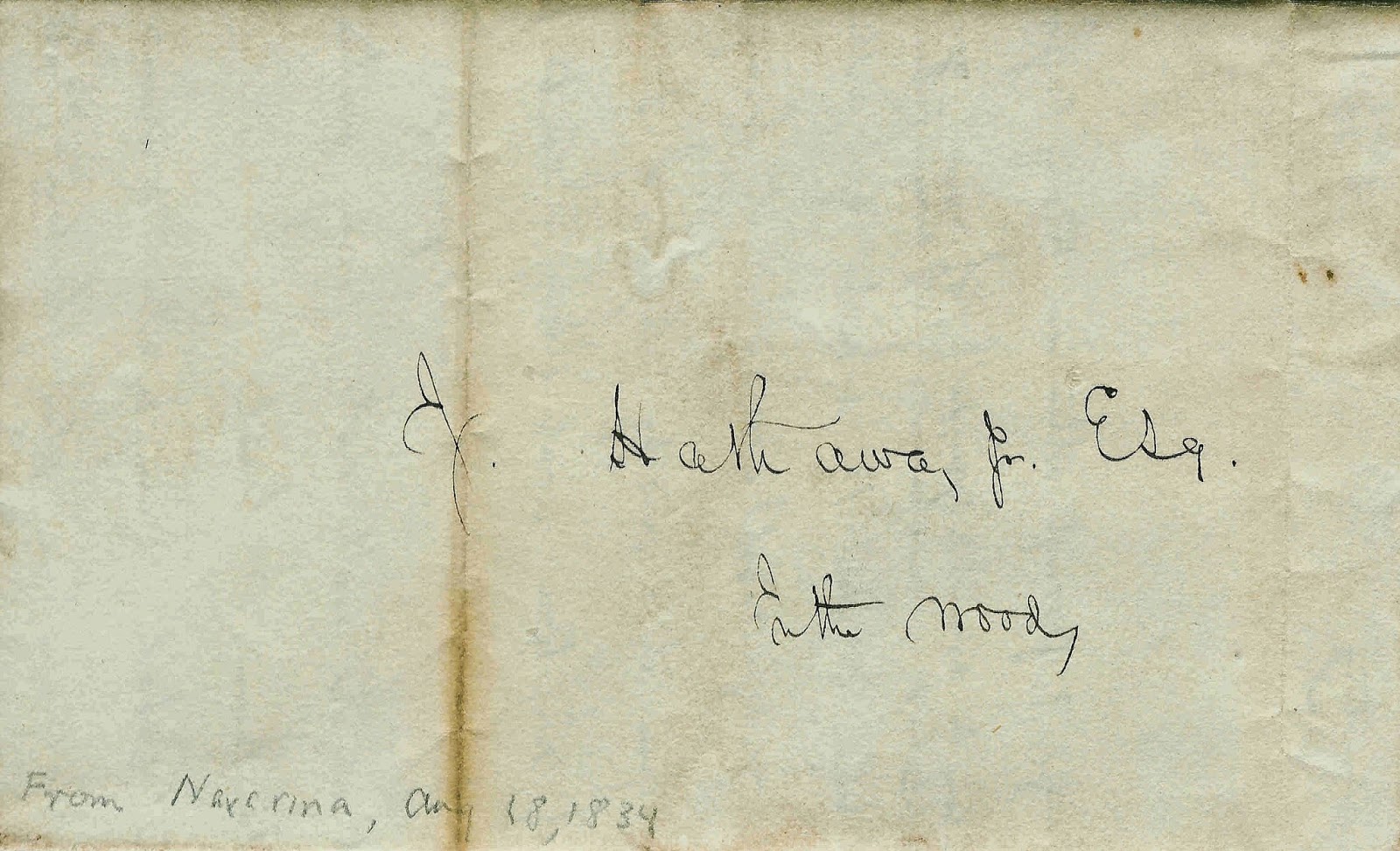
Morgan L. Martin was awaiting a steamboat when he penned a few lines to Hathaway on August 18, 1834. In the letter, he told Hathaway that they should be thinking of laying off a new county. Wisconsin was part of the Michigan Territory which was on the verge of statehood and Martin knew there was money to be made. Martin’s address on that letter to Hathaway was simply “In the Woods.” It is the first known letter to go through Kewaunee County, but was outside of government mail service, which had not yet been established. Hathaway received the letter, but how? This blogger questioned postal historian Bill Robinson who said that it was known in which area Hathaway was surveying. Martin’s letter was no doubt left at a place serving the public and when one was going in the direction, he took the letter as far as he was going and left it at another public place. One who stopped there while traveling took the letter in that direction and within a few days, Hathaway got his communication. The address was surely among the most unusual to go through Wisconsin, but the letter did arrive. And the county to be laid off? In 1838 Wisconsin Territory laid off Manitowoc County from Brown. Peter Johnson, who served as an oversight judge of the in Manitowoc's organization vote in March 1839, was elected as Collector.

Today - a period of slow home sales in Kewaunee County - the anticipated growth and money to be made in speculation in the mid-1830s seems incomprehensible. The county today numbers roughly 20,500 residents while in 1835 there was not one non-Native American inhabitant. Until 1851, the present Kewaunee County was a part of Brown County which was the taxing agent. By today's standards, the taxes on the heavily timbered land also seems incomprehensible, especially the land having a "water view." Tax records from 1838, for example, show Hathaway paying 21 cents on 56 1/2 acres valued at $70.63, 28 cents on 73.85 acres valued at $92.31 and 80 acres valued at $100 for 30 cents. Morgan L, Martin paid 29 cents for 79.10 acres valued at $98.88 and C.P. Arndt was charged 28 cents for 74.20 acres valued at $92.75. Time marches on!


Following is brief information about related people and events which have faded away.

*The map dates to 1850 when Calumet County came into existence and before Door County was laid off of Brown in 1851 and Kewaunee laid off of Door in 1852.

*The mouth of the Grand River is at today's Grand Haven, Michigan.

*Solomon P. Chase was elected to the Senate from Ohio in 1848. He became Ohio's first Republican governor in 1855 and served as Secretary of the Treasury under Abraham Lincoln during the early days of the Civil War. Lincoln appointed Chase as Chief Justice of the U.S. late in 1864. It was Chase who presided at the impeachment trial of President Andrew Johnson. Chase ran for the presidential nomination against Lincoln, but it was Lincoln who secured the nomination.

*Charles C.P. Arndt was a Green Bay attorney who was shot and killed on February 11, 1842 in the Wisconsin Territorial Council’s meeting room following a heated argument with James Vineyard. Vineyard was tried but was acquitted on self-defense grounds. When Arndt fell from the shot, he fell at the feet of his father who was a part of the same council.

*Judge Samuel Beardsley was also Attorney General of New York and the brother-in-law of Joshua Hathaway, Jr. It was through the influence of Beardsley that Hathaway won the appointment as a federal surveyor in the Northwest Territory.


Sources: Bill Robinson,postal historian interview 2009; Deborah Beaumont Martin,  History of Brown Co., 1913; Here Comes the Mail, Post Offices of Kewaunee County, c. 2010; History of Northern Wisconsin, c. 1881; Wisconsin, Its Story & Biography, Usher c. 1914.

Monday, March 9, 2015

Krok: Much More Than "A Crock!"

This cover was postmarked at the 3rd Krok post office in November 1898 just after Anton Swagel became postmaster.

Perusing an hors d’oeuvres table a few years ago, the conversation of two older men caught my attention. One was telling the other how he and his wife had sold the family farm, homesteaded by his great-grandpa well before 1900. As it turned out, the fellow was the much younger son of older parents. His father was also the younger son and, at the time, it was customary for the youngest son to inherit the farm, providing for his parents in their advancing years.

The gentleman continued saying he and his wife went through everything, cleaning out and clearing out what was stuffed in the attic during the last 100 years. They came across the most surprising things in the attic that because. after all, who has time to clean an attic full of junk when there is a farm to run?

Included  in the "junk" were old letters. As the conversation developed, chatter around the table faded as others began listening to an increasingly entertaining story. When he mentioned Krok, my ears really perked up. He was talking about Kewaunee County. The fellow’s grandparents were courting when the letters were written. She lived with her parents on the farm in Krok while her sweetheart had gone to find work in the big city – Milwaukee. His letters were addressed to her at “Krok, Kewaunee County, Wisconsin.” Letters were addressed to him at Harnishfeger Foundry, rather than his rooming house. He wasn’t in management; he was a laborer who received mail at the plant.

Kewaunee County postal history tells us there are three places named Krok and had I stopped to think, I could have answered the question that I put to him. I asked about the dates of the postmarks, prompting him to ask why I wanted to know. My response was that because there were three post offices named Krok, the post mark indicated the specific office. He didn’t miss a beat when he asked if I was telling him Kewaunee County was nothing but a crock! He had somewhat of an audience by then and it erupted with peals of laughter. He had been waiting to use the one-liner and my question was ripe. Krok and crock are not synonymous!

Krok defines an area in Kewaunee County today, but beyond a few miles few know it. It has lasted longer than Zavis, Rushford and Royal Creek, but just as in those places corn has replaced the halls, cheese factories, the saloons, mills or whatever might have been there. If corn could tell the stories in their roots, there would be some good ones. The gentleman at that hors d’ouerves table represents generations of Krok Bohemians who enjoyed socializing, telling stories while finding pleasure in a good drink and good food. He was not drinking a Bohemian pilsner or enjoying kolaches or knee-caps that night, but it was good just the same. And, incidentally, it was the last of the three Kroks that carried the post between his grandparents.

Krok #1
When Kewaunee was incorporated as a village in April 1873, the West Kewaunee of today was named Krok, a name given by Judge Woyta Stransky after his native home in Bohemia. Records indicate that the name Krok was abandoned in April 1881 when West Kewaunee came into being.

Stransky had served as sheriff and was postmaster when the first Krok post office opened on December 21, 1874. Stransky applied for the office which was located on the northeast side of the Kewaunee River in Section 14 of Town 23N, Ranger 24E. Located at Stransky’s mill, that first Krok post office closed four years later in November 1878.

Krok #2, 2007
After a six year hiatus, Krok post office reopened in May 1884, but this time it was in the northeast corner of Section 24, Town 23N, Range 23E. The Town of Montpelier. Joseph Shimonek (or Shimanek) took charge of the new office which was just about 2 miles east of Ellisville on what is now County Highway F. Why Shimonek’s office was only in business for two weeks before being closed is quite unusual and remains a mystery. Four years later, in April 1888, Krok post office was again back in business, back in West Kewaunee but this time in Section 3. Joseph J. Walecka was the postmaster at the place sometimes called Walecka’s Corner. Prokop J. Walecka followed him. Anton Swagel was Krok’s last postmaster, operating from his store, saloon and hotel.

Swagel's, Krok #3, just after 1900
Swagel's Krok 3 post office was discontinued on November 30, 1904 with the coming of Rural Free Delivery in Kewaunee County. Early post offices moved around frequently, as was the case with Krok. Some offices were surprisingly close to another office. Zavis opened in 1877. It was a mile and a half east of Krok 3, but Zavis closed in 1879, five years before Krok 2 came into being. There were needs to be served.

Postmaster Swagel profited far more than his predecessors in terms of postal remuneration. His 1901 compensation of $92.85 more than doubled his pay for any other year. However, the post office brought business to his store and saloon and that’s where his money was made.

Many of the pre-RFD postmasters were against such a service. RFD was an economic issue as home delivery brought more than personal letters. It brought current newspapers and magazines. One could get and digest the news at home without stopping at the saloon. If mail wasn’t picked up, fewer drinks were sold. Catalogues such as Sear-Roebuck and Montgomery Ward brought wants beyond the stock in rural stores, wants which could be delivered. It wasn’t only RFD that spurned the demise of postal communities though. Autos were making inroads and Algoma and Kewaunee, which already had telephone service, were seeing electricity. Time was marching on.

Had Krok survived the Advent of RFD, more than likely its postmark would be as popular as Christmas, Michigan, Zip Code 49862, Winter, Wisconsin 54896 and Hell, Michigan 48169. The U.S. has other spots such as Loveland, Colorado 80538 remembered only at holidays. For an elderly man, he has a real knee-slapper in his stories of growing up in a place that was nothing but a “Krok.”

Sources: Photos are from the blogger's collection; stories from an unidentified gentleman; postal information from Here Comes the Mail, Post Offices of Kewaunee County, c. 2010.

Monday, March 2, 2015

Hall's Mills: Kewaunee County's 1st Grist and Saw Mills


Abraham Hall was a Lake Michigan mariner until he lost his schooner Rochester off Two Rivers Point in 1848. Hall was shipping on the west shore of the lake but, without a vessel, entered the employ of John Volk’s Kewaunee lumbering business. He didn’t remain long and in May 1852 opened the first mercantile on the Door Peninsula.*  Known as Wolf River when Hall settled there, the place is called Algoma today.

The lumber Hall’s account book shows sold in 1851 appears to be in error based on land records, but from May 1852 on, there was a steady stream of notations of items sold, price and the names of purchasers who came from as far as Bailey’s Harbor and Sandy Bay, the town now known as Carlton.

Having opened his store, Hall began building his saw and grist mills on the South Branch of the (now) Ahnapee River just beyond the present Algoma Hardwoods. When Hall’s brother Simon and family arrived from New York in 1855, they moved into a log house near the frame store building, the log blacksmith shop and the mills and Simon began working with his brother.

Hall’s gristmill was the only such place east of Green Bay and north of Manitowoc. It drew customers from Door County and the southernmost parts of Kewaunee County who brought their grain by boat. It was a boon to the Belgians who had recently arrived in the two counties. As they walked through the thick forests, they carried grain sacks hanging down their backs attached to their heads with a corner of the sack wound in a cap-like fashion. Keeping their hands free, they could push away the almost impenetrable branches while carrying a stick to assist in walking or perhaps to frighten an animal.

Water powered the mill that was felt to be quite an impressive place. Impressive as it was for the time, Hall’s was a small mill compared to those being built 20 years later. Hall's high dam held the water in a mill pond thus furnishing the power. When the Record described the mill’s workings during the 1870s, it explained with the following: “To release water from the pond and permit it to flow thru the race and exert its forces against the paddles of the old water wheel that moved the machinery and made the stones go round, a small gate was raised by the aid of a long sweep lever.” 

Grinding was not always fine, said the paper, because the mill stones were old fashioned, however Hall’s stones were French burr stones that were thought to be far superior to any other, It was said the French stones speedily pulverized the grain to a uniform thickness. More than likely Hall’s stones came from John Noye’s warehouse in Buffalo, a place destroyed in a May 1879 fire.

The Hall mill had its own fires. When the grist and sawmills were destroyed by fire in late 1866 or early 1867, they were rebuilt only to burn again in the 1870s. The brothers were still operating in the spring of 1881 when “Anonymous” wrote a letter to the Record's editor. Anonymous called for a new first class mill that would meet the needs of residents while not being built “after the fashion of bygone days.” While the author felt a new mill would increase business, the author seemed to be saluting the accomplishments of the Halls, saying he didn’t want outsiders to come to compete with those who “assisted in developing the county.”Simon Hall and his sons went into milling at Maplewood, 10 or 12 miles north in Door County, after the brothers retired from the Ahnapee business in 1888,

As the timber along the river and in the surrounding area disappeared, the need for a small mill disappeared as well. As new and more modern gristmills were being built, Hall’s faded away. The machinery was removed and it wasn’t long before the old mill began its decay. Michael Haney and his brother John owned the property in 1893 when a storm leveled the old frame structure, the oldest mill in the county. The grist mill, which was connected to the sawmill, saw little damage then. Eventually some of the buildings were razed and in time the dam washed away.

The postcard dates to the early 1900s after the dam mill had deterioriated and the dam had washed away. The photo was taken facing northeast toward Plumbers Woodwork, the large brownish building. The Veneer and Seating Co., today the Hardwoods, is visible to the right of the Plumbers, behind the trees.
During the cleanup after the Haneys bought the property, one of the old mill stones was among the articles they found. The Haney brothers felt they were preserving history by saving one old, well preserved and almost perfect stone when they put it in the wall of the new one-story brick structure they built in 1906 on the southeast corner of 2nd and Steele.  The Haney building was sold and resold over the years, finally being torn down and replaced with the Savings and Loan building that is now the Bank of Luxemburg. The old millstone was lost during demolition and surely buried in some landfill. It was found during the clean-up 100 years ago and might well be found again. Will anybody know what it is or that it came from the first gristmill on the Peninsula?


*Door County was created in 1851. Kewaunee was set off from Door in 1852. Jacques Vieau had a “jack knife” trading post along Jambo Creek years before. He was also known to be in Kewaunee at times. A “jack knife” trading post was one that opened and closed quickly.


Sources: Ahnapee Record; The Commercial Development in Algoma, Wisconsin c. 2006; Here Comes the Mail, Post Offices of Kewaunee County, c. 2010; Old Peninsula Days, Hjalmar Holand, c. 1925; Yours Truly, From Kewaunee County, c. 2013.

Wednesday, February 25, 2015

The Town of Lincoln: A Hotspot for Doctors


U.S. Census figures tell us that based on percentage of population, Kewaunee County's Town of Lincoln is the 4th largest Belgian-American township in the United States today. Most immigration occurred in the late 1850s when the area was originally called GrandLez, named for a place in the Province of Namur, Belgium.

Within 35 years those Town of Lincoln immigrants produced 6 men who would become medical doctors. Why all those doctors? That most are Belgian is not surprising. Lincoln was filled with young immigrants raising large families, a fact reflected in the 1880 Eleventh Census of the United States which counted 1,147 residents in the town's growing population. 

One of those doctors, Dr. Edward J. Kerscher, was among the town's most prominent and beloved citizens. Of German descent, he was born there in 1885 and taught school in Euren* before attending medical school. As one held high in regard in both Door and Kewaunee Counties, he was feted at a day in his honor in June 1950. Nearly 25 years later, on March 22, 1974, Wisconsin Assembly passed a Resolution honoring Kerscher on his 89th birthday.  Kerscher’s predecessor Dr. LaFortune was practicing in the hamlet of Lincoln in 1887, planning to relocate to Bottkolville (Euren) later in the year. Dr. Kerscher followed him. When Kerscher was honored, it was noted that he spoke German, Belgian and English, but more than likely the others did too.

Green Bay's Bellin Hospital was founded by Dr. Julius Bellin, born in Lincoln in 1870. The father of former Green Bay Mayor Sam Halloin also went from Lincoln to make a mark on Green Bay. Records say Dr. Louis Halloin was born in Lincoln Town, though other records say he was born in the Town of Red River. But, he definitely practiced in Lincoln where he and his wife were known as "pedagogues." Finishing at New York's Rush Medical School in May 1887, Dr. John J. Looze was welcomed back to the area. At the time the Record reported him to be an "ambitious man of exemplary habits who deserves a good practice." Looze didn't remain in the county for the rest of his life as he relocated to Seymour in January 1898. Dr. William Witcpalek was a Bohemian who was born on a farm in Lincoln in 1871, just three months before the horrific event that came to be called the Peshtigo Fire.

Bizarre - or even hilarious - as it is today, Witcpalek left school to work in a meat market. It was said he was a competent butcher who eventually bought an interest in a butcher shop. He returned to school and became a teacher, serving in Lincoln for a few years, and then at other schools until 1907 when he moved his wife and children to Milwaukee so he could attend medical school. Two years later he went to Northwestern University, graduating in medicine and dentistry in 1911 and opening his Algoma practice in 1914. Witcpalek was said to inherit his desire to serve the sick from his mother mother, an herbalist and midwife.

Dr. Herb Foshion was another Belgian physician, born in 1895 at Thiry Daems, in Red River Town, a stone's throw from the others' birthplaces.  From there his family moved to the Town of Gardner in Door County. He attended Algoma High School and Door-Kewaunee County Normal School, not because he wanted to be a teacher, but because he wanted to further his education. Foshion enrolled in medical school at UW-Madison, an education interrupted by World War l. Receiving his M.D. degree at the University of Minnesota in 1923, Foshion arrived in Algoma on January 1, 1925 where, a few years later, he spear-headed a community hospital such as Bellin had done in Green Bay a few years earlier. Foshion wasn't born in the Town of Lincoln, but he was Belgian and the second to organize a hospital.

So why did all those men become doctors? It has been suggested they were children of those who had experienced the horrors of the Peshtigo fire and knew the way to a better life was a an education and making money. However, country doctors didn't make much money and often times were paid in fireplace wood, a pig, bushels of apples or whatever medium could be used. Perhaps those men recognized a need and filled it.

For generations following immigration, the Belgian-Americans were an insular people. Though other immigrant groups stuck together, they gradually assimilated. Assimilation took the Belgians generations however, and no doubt the assimilation was rooted in school consolidation.

Schools in the Belgian districts were thought to be of lesser quality than the non-Belgian districts. In the early days, an education wasn't essential. It was clearing the land, raising crops, cutting wood and everything else crucial for a survival that was little more than subsistence.  It was not only the Belgians who relied on those within their community. Those sharing a common language offered protection and comfort. There were always folk remedies such as poultices for colds and fevers, herbal teas for constipation and such complaints. Even cobwebs were regarded as valuable for stopping bleeding. Typhoid and diphtheria wiped out entire families and some never recovered from the grippe. Forests were so dense in the early days that getting the sick to a doctor would have been nearly impossible. Even as forests were cut down, travel and distance remained a drawback.

The six Town of Lincoln doctors provided an exceptional service to the Belgian community and to Kewaunee County beyond. Kerscher has  record of sorts among Wisconsin's country doctors. When he retired, it was noted that he had delivered over 4,100 babies.

For whatever reason, capable, hard-working men born within a few miles of each other within a generation gave all they had to family, relatives, neighbors and friends and those they met for the first time. They spoke the language and they were trusted. 

Algoma no longer has the hospital that began with Foshion, however its residents, those in Kewaunee County and all over Northeast Wisconsin are served at Bellin Hospital. Julius Bellin lives on. So do the other men!


*Euren was also known as Bottkolville and given its name by the Bottkol family that settled the area. Euren takes that name from the place from which the Bottkols came near Trier, Germany. Thiry Daems in Red River Township is an easy bike ride from any of the other birthplaces. Grandma's first cousin was one of the deaconesses working with Dr. Bellin at the founding of the hospital.

Sources include Ahnapee Record, Algoma Record Herald, Ancestry and Wikipedia.